

Local SEO for Chennai SMEs: A Practical Guide to Getting Found Online
A step-by-step guide to local SEO for Chennai and Tamil Nadu SMEs: Google Business Profile, NAP consistency, keywords, and a realistic 30-day action plan.
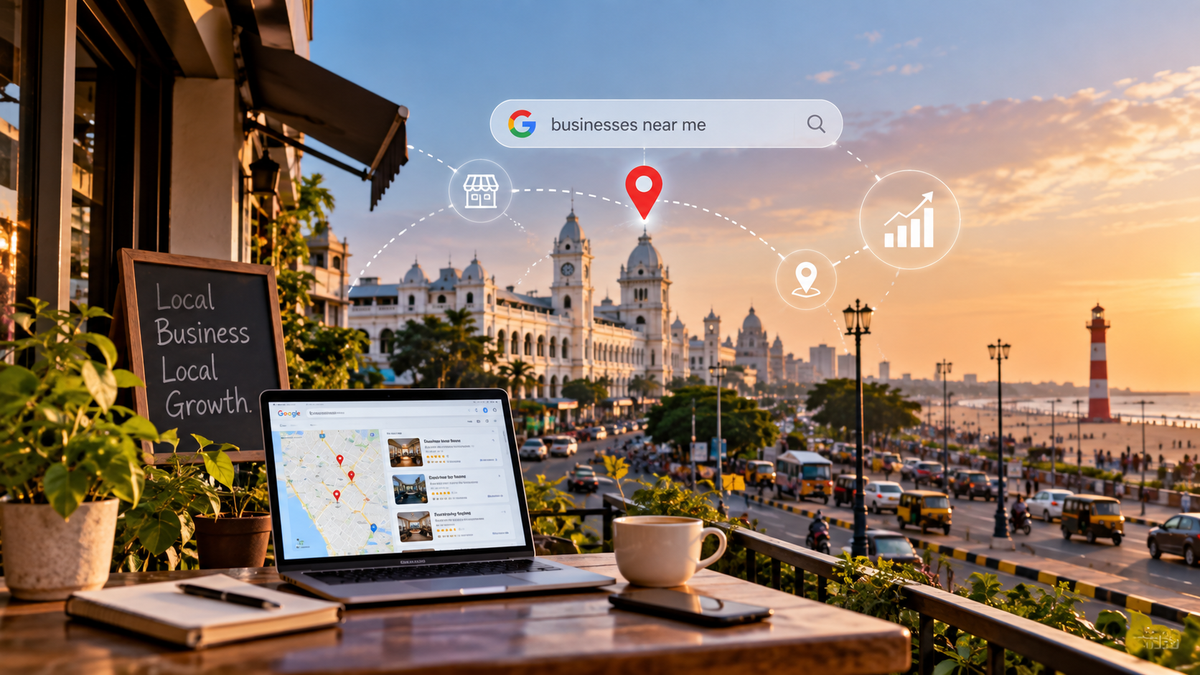
If you run a shop, clinic, salon, restaurant, or service business in Chennai or anywhere in Tamil Nadu, most of your potential customers are already searching for you on Google before they ever find you any other way. The problem is that "searching" and "finding" are two very different things — and for most small and medium businesses, the gap between them comes down to one overlooked discipline: local SEO.
Local SEO is simply the practice of making sure your business shows up when someone nearby searches for what you offer — "tailor near Anna Nagar," "best dentist in Velachery," "packers and movers Chennai." Unlike broad SEO, which competes for national or global rankings, local SEO is winnable for a small business with a modest budget, provided you approach it systematically. This guide walks through what actually matters, in the order it matters, so you can start today.
What Local SEO Actually Means for a Chennai SME
When someone searches on Google, the results usually split into two groups: the "map pack" (three business listings shown with a map, pins, ratings, and hours) and the regular blue-link organic results below it. Local SEO is the work of earning a strong position in both, specifically for searches that carry local intent — meaning Google has decided the person searching wants a business nearby, not just information.
For a Chennai-based business, this matters more than most owners realize. A large share of local searches on mobile lead to a visit, call, or purchase within a day, and being absent or poorly optimized in these results is, in practical terms, the same as being invisible to a customer standing two streets away.
The Building Blocks of Local SEO
1. Your Google Business Profile (GBP)
This free listing is the single highest-leverage asset in local SEO. It is what populates the map pack, and an incomplete or neglected profile is the most common reason a good business ranks poorly. At minimum, it should be:
- Claimed and verified, with the correct business category (choose the most specific one available, not the broadest).
- Filled out completely: accurate hours, service area, phone number, website, and a written description that naturally includes what you do and where you serve.
- Updated regularly with photos, offers, and short posts — profiles that show recent activity tend to be treated more favourably.
- Actively collecting and responding to reviews, including a brief, professional reply to negative ones.
2. NAP Consistency (Name, Address, Phone)
Google cross-checks your business details against other places they appear online — your website, Justdial, Sulekha, IndiaMART, Facebook, and industry directories. When your name, address, or phone number is written differently across these (a shortened street name here, a missing suite number there), it creates doubt in Google's system about whether these are even the same business. A one-time audit to align every listing to a single, exact format is one of the highest-return exercises available and typically takes a few hours to complete across the major directories.
3. Local Keywords and On-Page Signals
Your website itself should reinforce your location. That means working your city and neighbourhood names naturally into page titles, headings, and body copy — "accounting services in T. Nagar" rather than just "accounting services." If you serve multiple areas of Chennai, or both Chennai and Singapore, dedicated pages for each major service area (rather than one generic "locations" page) tend to perform noticeably better in local search.
A Simple 30-Day Local SEO Action Plan
- Claim or fully update your Google Business Profile, and add at least 10 real photos of your premises, team, and work.
- Audit your business name, address, and phone number across your website, GBP, and top 5 directories; fix any mismatches.
- Add or rewrite your website's homepage and "About" page to clearly state your city and service areas.
- Set up a simple, polite system to ask satisfied customers for a Google review — a QR code at the counter or a WhatsApp follow-up message works well.
- Post one update or offer on your Google Business Profile each week.
- Check that your website loads quickly and works cleanly on mobile, since the majority of local searches happen on a phone.
Common Mistakes SMEs Make with Local SEO
- Listing a home address or a P.O. box on GBP when it isn't customer-facing, which can trigger a suspension.
- Stuffing the business name field with keywords ("ABC Bakery Best Cakes Chennai") — this violates Google's guidelines and risks the listing being removed.
- Ignoring reviews entirely, both positive and negative, which signals inactivity to both customers and Google.
- Treating local SEO as a one-time setup rather than an ongoing habit — profiles and rankings drift without regular attention.
What Results Can You Realistically Expect?
Local SEO is generally faster to show movement than broad organic SEO, but it is not instant. As a rough estimate, a business that consistently applies the steps above can often see meaningful improvement in map pack visibility within 6 to 10 weeks, with more competitive categories (like restaurants or clinics in dense areas) taking longer. These are estimates based on typical patterns, not guarantees — results vary by category, competition, and how consistently the work is kept up.
Ready to Get Found by More Local Customers?
Local SEO rewards consistency more than complexity, but it does take time most SME owners don't have to spare. If you'd rather have someone set it up correctly and keep it running while you focus on the business itself, we can help.
Book a free consultation with Grow Spark Consulting and we'll walk through where your business currently stands in local search and what the fastest wins would be.